
Manager Controls
Helping admins share group management without giving up control.
Domain:
Social Networking
Role:
UI/UX Designer
Team:
Product Manager · Developers · Designers · Stakeholders
Duration:
6 months
Platform:
Ios, Android
Note : This project was designed for a pre-launch product. Product branding and selected screens have been modified due to a non-disclosure agreement. Designs were refined through stakeholder reviews before engineering handoff.
Challenges
One admin was responsible for everything.
Before Managers, the admin was the only person who could manage members, content, and group settings.
As groups grow, relying on one person to manage everything becomes difficult to scale. We needed to introduce a Manager role that allowed admins to share responsibilities while retaining control.
How might we introduce shared management without making group controls harder to navigate?
Design Evolution
Every feature began with low-fidelity wireframes to explore layouts, navigation, and information hierarchy. Through stakeholder feedback and multiple iterations, these concepts evolved into the final product experience.

Key Design Initiatives
This project consisted of three design initiatives that supported the platform's transition into a community-driven experience.
01 — Discover & Scale
Problem Faced:
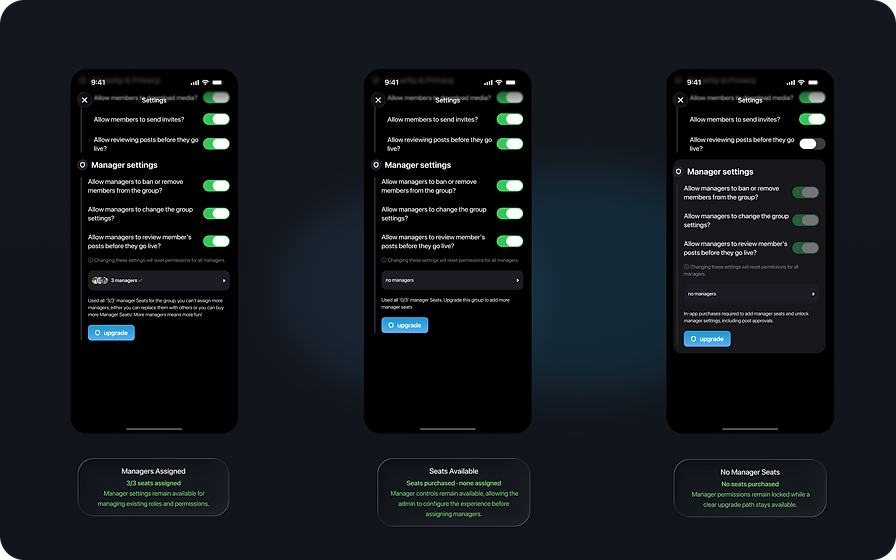
Managers was a new capability. Admins needed to discover it naturally, understand their available manager capacity, and know what to do when more seats were needed.
My Approach:
I introduced Manager Settings within Group Settings, keeping the feature where admins already manage their group.
I also kept manager capacity and upgrades within the same journey instead of sending admins to a separate billing experience.
Group Settings → Manager Settings → Managers / Upgrade
Designing for Different States
Outcome:
A single entry point that connects manager discovery, capacity, and upgrades without breaking the admin's flow.
Discovering Manager Settings and adding manager capacity.
02 — Add & Manage
Problem Faced:
Admins needed a simple way to add trusted people as managers and manage their roles without confusing role changes with group membership changes.
My Approach:
I centralized manager actions in one place, allowing admins to add people from existing members or friends and manage each person's role individually.
I deliberately separated Remove as Manager from Remove / Ban Member, so changing someone's responsibility doesn't remove them from the group.
Managers → Add Manager → Select Person → Confirm
Adding and managing managers from one central location.
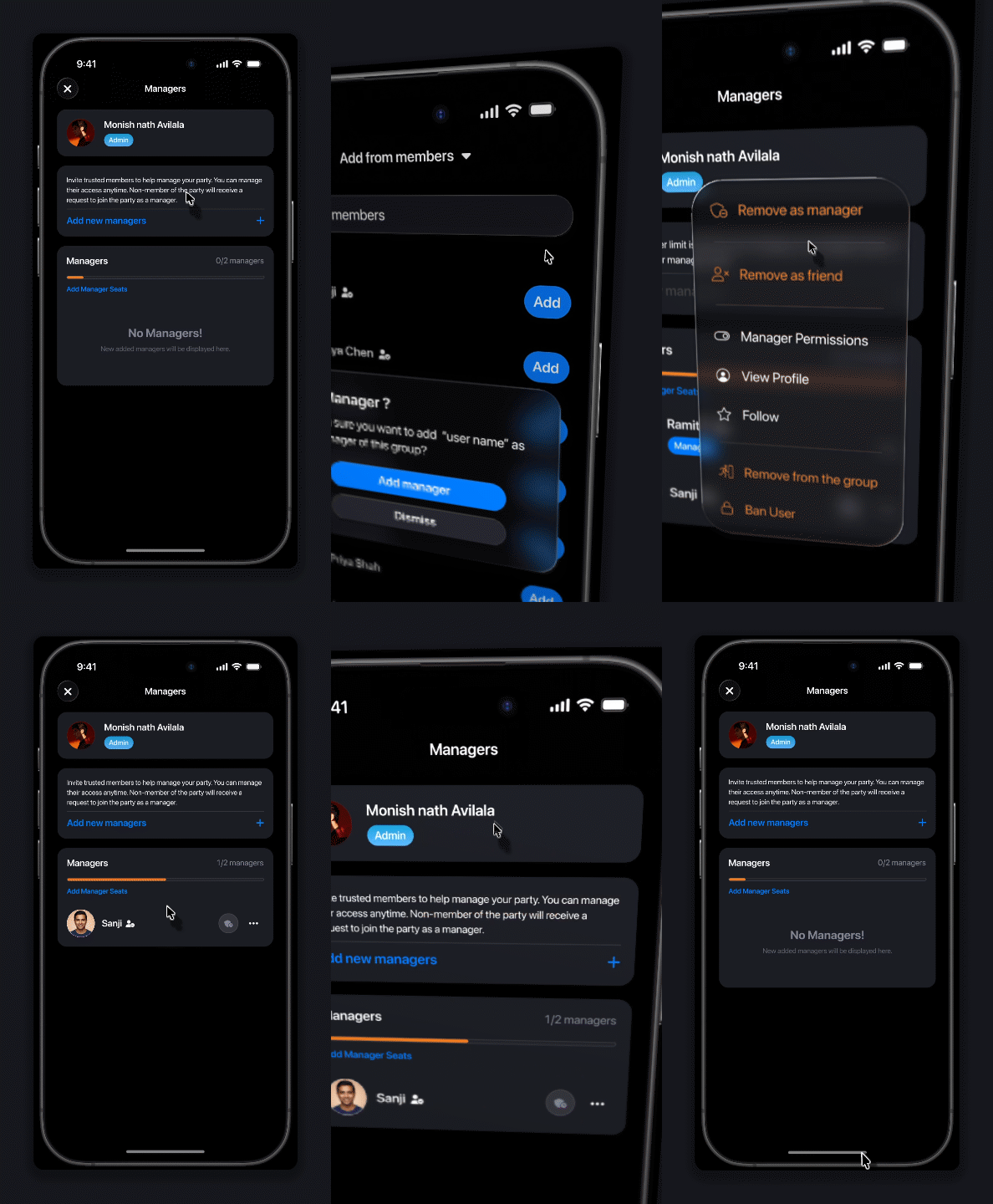
Designing for Key States

Role Visibility
Badges make roles and pending requests easy to recognize at a glance.

Outcome:
One predictable place to add and manage managers, with clear next steps across different capacity states.
03 — Configure Permissions
Problem Faced:
Not every manager needs the same level of control.
Some may only need to moderate members or review posts, while others may need broader access to group settings. Giving every manager full control would limit the admin's ability to delegate safely.
My Approach:
I designed permissions around specific responsibilities, allowing admins to decide what each manager can manage.
Members/Managers page → Manager Details → Permissions
Admins can grant access to actions such as removing members, reviewing posts, and managing group settings, with more sensitive controls placed deeper in the hierarchy.
This keeps basic permissions easy to understand while making granular controls available when needed.
Configuring access based on each manager's responsibilities.
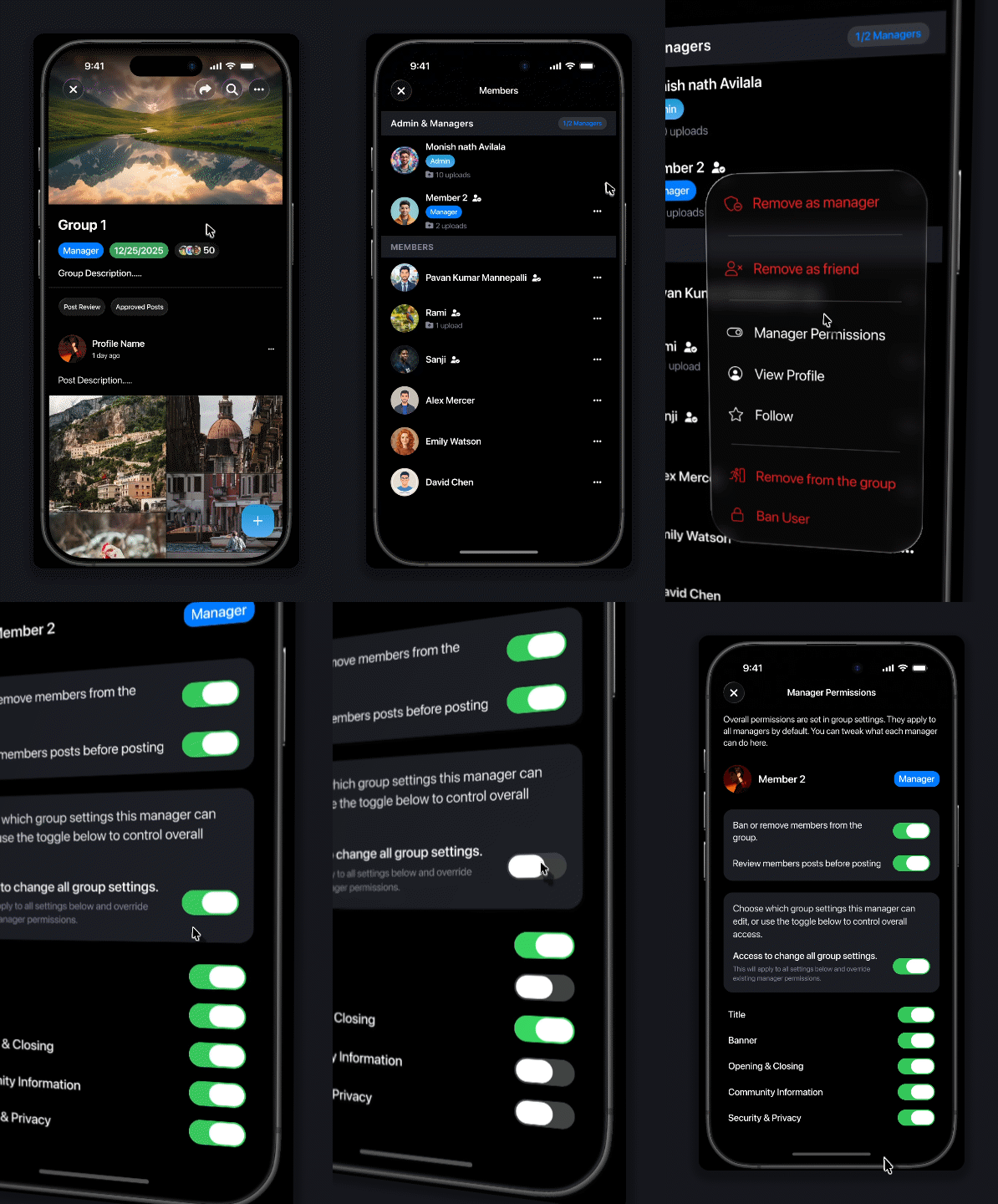
From Permission to Action
To make permissions meaningful, I connected them directly to the tasks managers perform.
Post Review is one example. When this permission is enabled, managers can review submitted posts and decide what gets published directly on the group feed.
Uploaded → Awaiting Approval → Review → Approve / Reject

Outcome:
The permission model connects access to real responsibilities, allowing admins to delegate tasks like post moderation while retaining control over the group.
Project Outcome
30+
Production-ready Screens
5+
Multi path user flows
10+
System and role states
3+
Core Design Initiatives
1
Scalable Management System
Conclusion
Designing Manager Controls went beyond adding a new role. It meant thinking through navigation, multi-path flows, permissions, system states, and moderation as one connected experience.
The result is a scalable foundation that lets admins share responsibility without losing control, while giving managers clear boundaries around what they can access and do.
A flexible system designed to grow with the community.
